





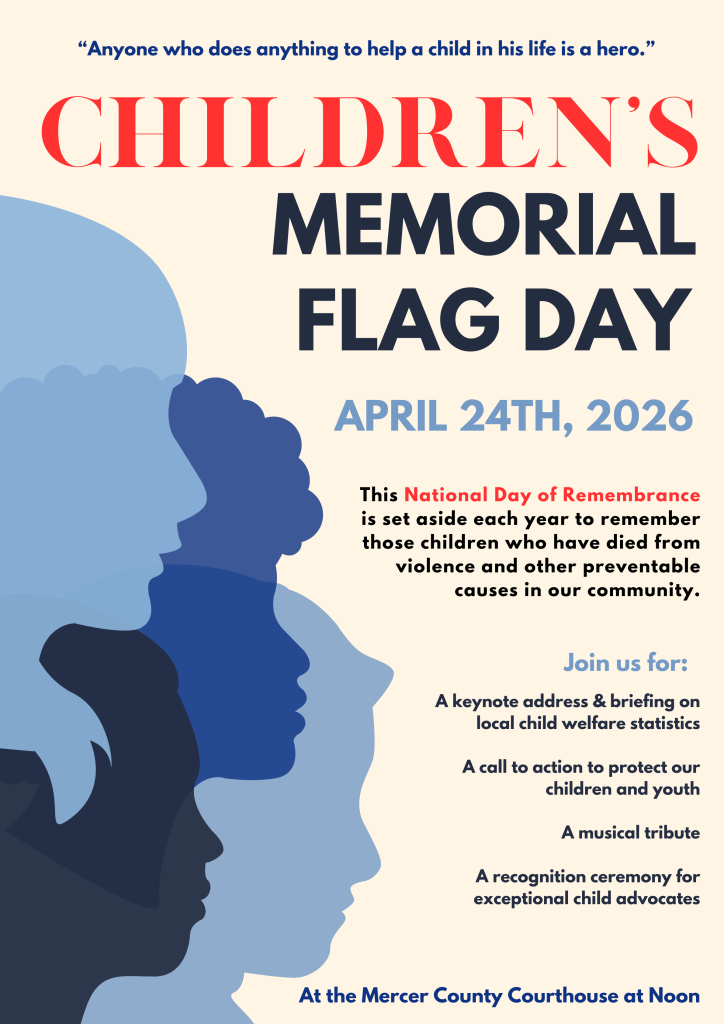
This National Day of Remembrance is set aside each year to remember those children who died from violence, and other preventable causes in our community. The fourth Friday in April was officially designated as National Children’s Memorial Flag day by the US House of Representatives in 2001. Too often, headlines and newscasts report the tragedies of a child who was beaten, an infant who was shaken, a child who was accidentally shot and killed, a teen who succumbed to a drug over-dose, or children killed by a drunk driver, or other substance use related car wrecks. The Children’s Memorial Flag honors each lost child, and serves as a symbol for the protection of children and youth from all forms of violence. About 12,000 children and young adults ages one to nineteen years die from unintentional injuries each year according to the Center for Disease Control and Prevention (CDC).
The Children’s Memorial Flag Day Event Committee (staff from Children’s Home Society of WV, WV Department of Human Services, Child Protect of Mercer County, ChildLaw Services, Inc, Community Connections, Inc.) has organized this event to honor child victims; bring awareness to this community problem; re-energize our efforts to protect and care for local children; and to recognize notable efforts in our community to keep children safe, nurtured, and protected. This year’s event will feature a keynote address, a musical tribute, a briefing on local child abuse statistics and a call to action and re-commitment to protect our children with a bell ringing for each of West Virginia’s preventable child fatalities. Exceptional Child Advocates will be recognized and the winners of the Primary School Coloring Contest will be announced. The Children’s Memorial Flag Day event will conclude with the 20th Annual Remembrance Walk around the Mercer County Courthouse.
April is also Child Abuse Prevention Month.
According to the National Children’s Alliance, in 2022 an estimated 558,899 children were confirmed victims of abuse and neglect in the United States, the most recent year for which there is national data. Additionally, it is reported that nearly 2,000 (1,990) of these children died from their abuse and neglect. Despite the sobering and grim reality of child maltreatment, communities are diligently working to improve these statistics and the lives of children. There are state and legal protections to investigate and prosecute reported incidents of abuse. Agencies and entities like DoHS and Child Protective Services, Judges and Prosecutors, Law Enforcement, and Child Protect of Mercer County stand in place to protect these most vulnerable citizens. There are services to support these child victims, like therapy, foster care and kinship care, forensic interviewing, legal representation (Guardian Ad Lietems), supervised visitation, mentoring, and various advocacy efforts to help meet their unique needs and treat trauma exposure. There are even preventative efforts to combat child abuse, such as Body Safety presentations in the schools and awareness events and initiatives like Children’s Memorial Flag Day and Child Abuse Prevention Month. Most importantly, prevention is achieved through programs that address the underlying causes of abuse. Pervasive social issues, like child abuse and maltreatment, require a united community response to combat the issue on multiple fronts.
Everyone has a part to play in the prevention of and response to child abuse in the local community. First and foremost, anyone can report suspected child abuse and maltreatment when they see or hear something that indicates a child is being hurt. Community members who seek to make a difference may also open their home and become foster parents to children in need of a safe, nurturing family, or volunteer with youth development organizations and programs, such as the WECAN Mentoring Program at Children’s Home Society, or Camp Mariposa at Community Connections, Inc. Still yet, others may donate to local family resource and support centers, like Starting Points FSC. Together, entities like those mentioned, work diligently to not only protect children, but provide adequate support to families. When families are well cared for, receiving the support and help they need, children are nurtured, safe, and thriving.